Multi-Dimensional
Skill Profiling
Assign agents composite skill scores across language, product knowledge, customer tier, issue type, channel proficiency for precise matching.

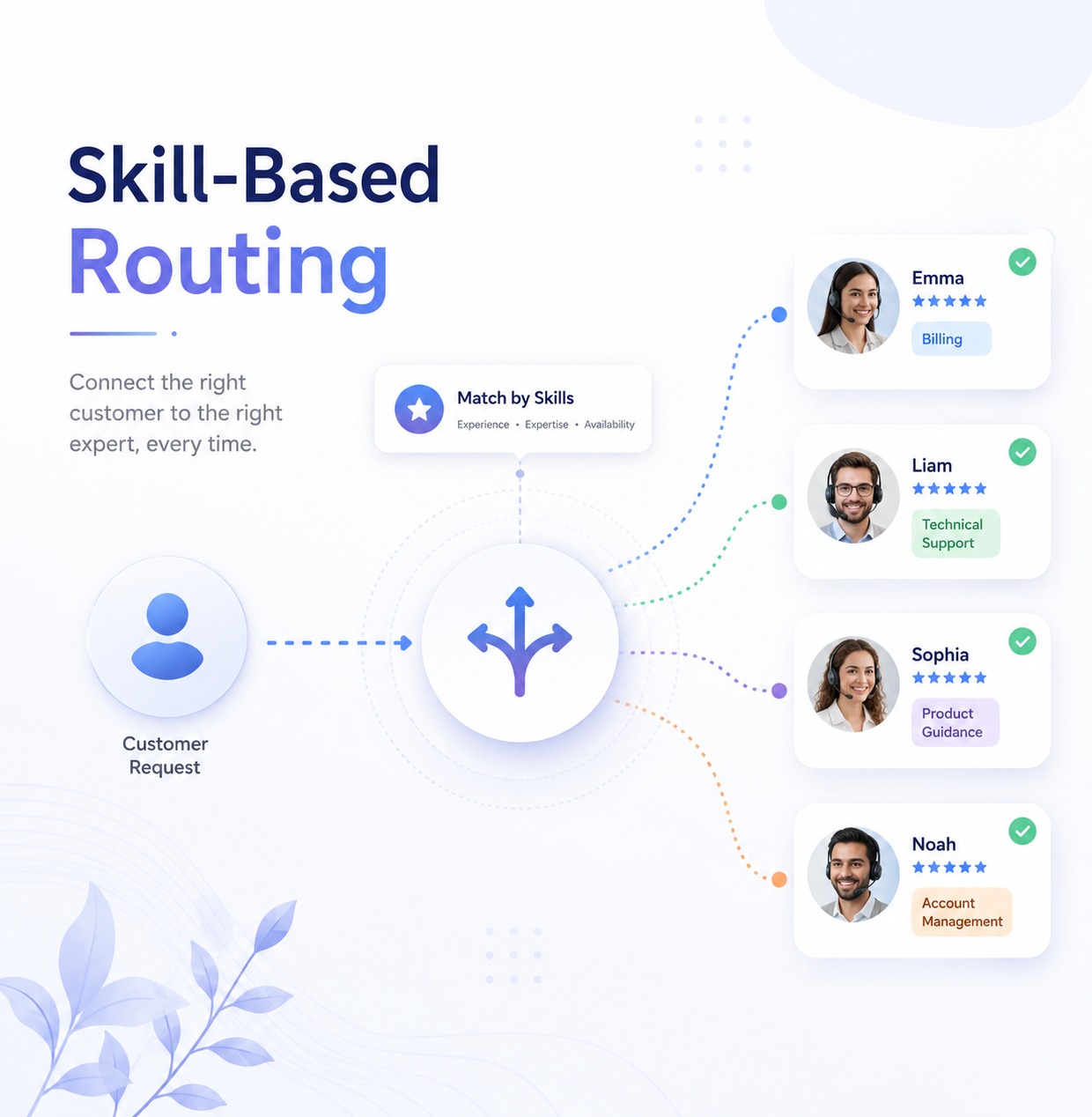
Not every agent can handle every conversation equally well — and your customers know the difference. Skill-based routing uses a sophisticated matching engine to direct each incoming contact to the agent who is best equipped to resolve it quickly and well. The result is fewer transfers, shorter handle times, higher first-contact resolution, customers who hang up feeling genuinely helped rather than merely processed.
Benifits of Skill-Based Routing
Matched agents resolve issues faster and more completely, dramatically cutting the volume of costly repeat contacts and escalations.
Customers who reach a capable, knowledgeable agent the first time are measurably more satisfied — and far more likely to stay loyal.
Routing work to agents based on capability rather than availability distributes effort more equitably and improves overall team efficiency.
Agents working within their areas of expertise resolve calls faster, creating capacity across the entire operation without adding headcount.
Skill-performance data pinpoints exactly where coaching investment will deliver the greatest improvement in routing outcomes.
Fewer mismatched contacts reach the wrong agent, which directly reduces escalations, supervisor involvement, associated operational cost.
Features of Skill-Based Routing
Assign agents composite skill scores across language, product knowledge, customer tier, issue type, channel proficiency for precise matching.
High-value customers or escalated contacts automatically join a priority queue and are matched to your most senior available agents without supervisors needing to intervene manually
Define threshold-based overflow logic that gracefully widens the matching criteria during high-volume periods, preventing abandoned contacts and unacceptable wait times.
Live dashboards show queue depth, average wait by skill group, agent utilisation so supervisors can rebalance staffing decisions on the fly
Supervisors can temporarily expand or restrict individual agent skill assignments during unexpected demand spikes without restarting the system.
Correlate skill assignments with CSAT scores and resolution rates to continuously refine your routing logic and training priorities.
Why This Solution